Monon 30
Location: Indianapolis, Indiana
Scale: Over 65,000 sq. ft. facility
Function: New 6-story Hotel structure for Hyatt using shipping containers and Vrecast wall and roof system.
VREcast Role: Stair towers, elevator towers and restaurant area to be built using Vrecast system. Supported fast-track construction by enabling installation parallel to other structural works, significantly compressing the project timeline.
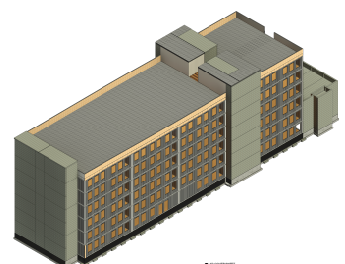
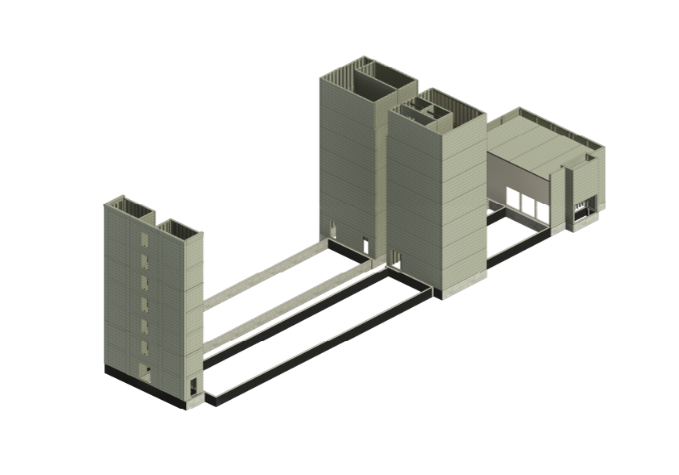
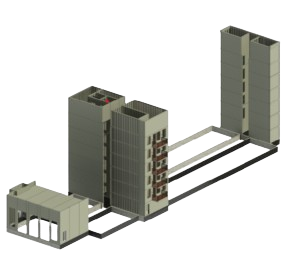
The Monon 30 Hotel is a 6-story Hyatt property in Indianapolis, Indiana, that demonstrates innovative hybrid construction by combining shipping container hotel room modules with VREcast’s engineered composite system for vertical circulation and common areas. Rising 69 feet across seven construction levels and spanning approximately 65 feet by 70 feet, the project intelligently integrates two complementary building technologies: containers deliver efficient, factory-finished hotel rooms, while VREcast provides the structural cores and open spaces that containers cannot achieve.
VREcast’s scope encompasses the complete vertical infrastructure: two full-height stair towers serving as primary and secondary egress, one precision-engineered elevator shaft serving all levels, and ground-floor restaurant structural walls with 24-30 foot column-free spans. Each component arrived as a factory-finished assembly with completed exterior surfaces, pre-installed MEP penetrations is optional, and engineered connections coordinated for integration with both concrete foundations and steel container modules.
The stair tower panels arriving with pre-framed door openings and smooth concrete surfaces requiring field drywall, taping, or painting. The elevator shaft achieved the critical ±1/8 inch tolerances required for reliable operation through factory-controlled manufacturing and immediately ready for elevator contractor equipment installation after erection. Restaurant walls simultaneously functioning as load-bearing structure supporting roof Vrecast floor elements above will be the exterior enclosure requiring finished interior surfaces after erection.
VREcast’s factory-manufactured approach transformed the construction sequence from sequential to parallel execution. While foundations were constructed during weeks 1-4, VREcast panels were simultaneously manufactured and container modules were fitted out. The moment foundations completed, vertical cores installed in under three weeks, with container stacking commencing immediately rather than waiting 12-16 weeks for traditional cast-in-place concrete cores to cure and be finished. This parallel workflow compressed the overall timeline from 20-25 weeks to approximately 9-10 weeks—a 60% reduction.
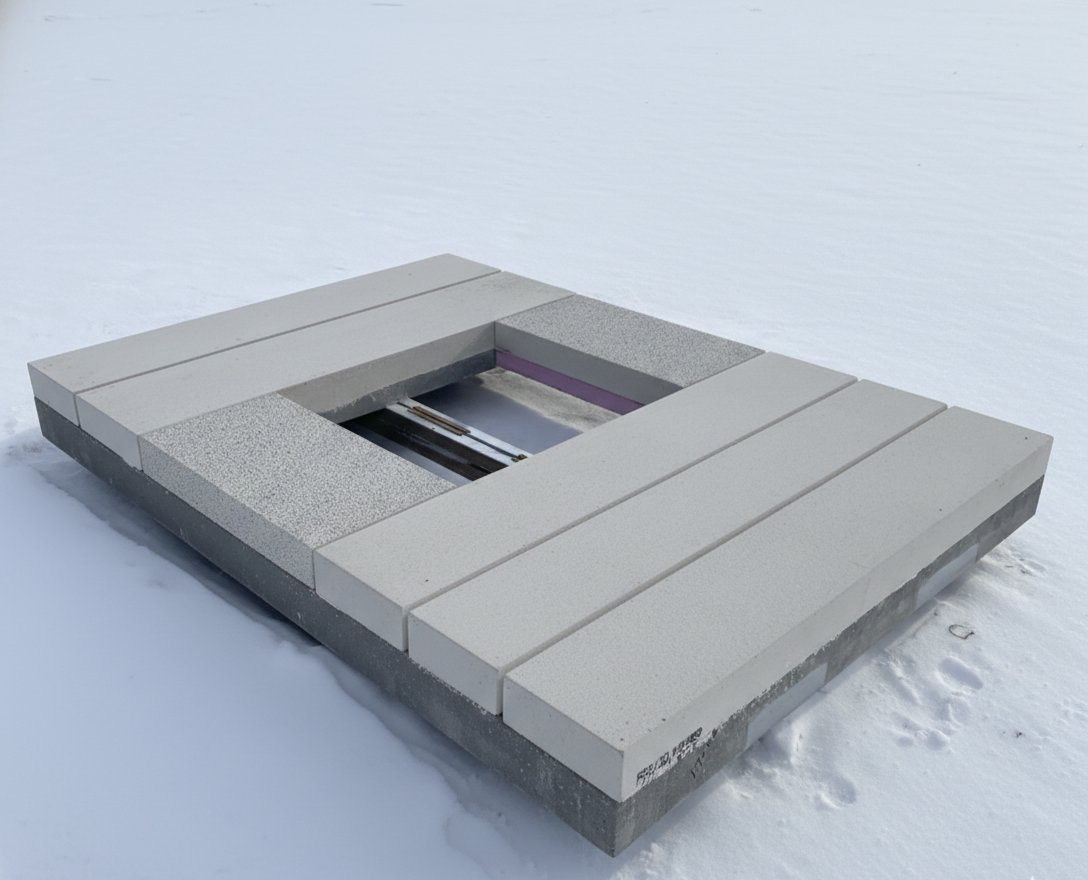
The composite construction technology integrates cold-formed steel framing with concrete using Glass Fiber Reinforced Polymer (GFRP) bars, creating lightweight panels with multi-story load-bearing capacity. The CFS framework accommodates all MEP services within panel cavities, with factory-installed penetrations and embedments eliminating field coordination conflicts. A 1/4″ separation gap between the concrete interior wythe and CFS framing eliminates thermal bridging entirely, achieving a 100% thermal break while maintaining structural integrity through non-conductive GFRP connecting elements. Factory-applied finishes on exterior faces match container module exterior factor modified quality, ensuring seamless aesthetic transitions throughout and the interior finishes can be matched on-site with seamless transitions at guest circulation paths.
Structural engineering by Splendid Engineering Inc. of New Berlin, Wisconsin, integrated three dissimilar systems—VREcast composite panels, steel shipping containers, and reinforced concrete foundations—with connection details addressing differential movement, thermal expansion, and load transfer paths. The project establishes a replicable model for mid-rise hospitality construction, proving that modular speed can extend beyond low-rise applications when paired with complementary systems addressing modular components’ structural and architectural limitations.
METRIC
SPECIFICATION/DETAIL
Wall Thickness
10 1/4″ thickness (Without Drywall)
Composite Connector
GFRP Zig-zag bars
Thermal Mitigation
¼” separation gap between concrete and metal studs (no thermal bridging) and 4″ spray insulation with R-value of minimum 5 per inch.
Concrete Face
Varies from 2 1/4″ to 4″
THE CHALLENGE
Building a 6-story hotel on an aggressive timeline requires parallel construction sequences that traditional methods cannot support. The project needed:
- Vertical circulation cores (stairs and elevators) that could be installed independently of container placement
- Restaurant and common areas requiring larger, column-free spans than containers could provide
- Structural components ready for immediate installation to avoid delaying container stacking operations
- Engineered systems capable of integrating seamlessly with modular container units
Traditional cast-in-place concrete would create sequential dependencies and weather delays. Steel frame construction would require extensive field welding and coordination. The solution needed to match the speed of modular construction while providing superior structural performance.
ROLE OF VRECAST
The VREcast system was selected to solve the hybrid construction challenge—delivering factory-precision vertical cores that install as fast as the container modules they serve:
Composite Construction Technology:
- Cold-formed steel (CFS) structurally integrated with concrete using Glass Fiber Reinforced Polymer (GFRP) bars for structural integrity, thermal efficiency, and durability
- Multi-story load-bearing capacity supporting six levels of stacked containers while remaining lightweight for rapid crane installation
- Engineered connections bridging three dissimilar systems: VREcast composite panels, steel shipping containers, and concrete foundations
MEP Integration & Coordination:
- Integrated CFS framework accommodating all mechanical, electrical, and plumbing services within panel cavity spacing
- Factory-installed penetrations, vertical chases, and elevator guide rail embedments across seven floor levels
- Pre-coordinated systems eliminating field conflicts in confined vertical shafts
Architectural Adaptability:
- Factory-applied smooth finish on exterior faces—no drywall, no insulation, no taping, no painting for factory-applied product and need to be installed after erection and during the construction process.
- Precision manufacturing achieving ±1/8″ elevator tolerances across 69-foot shaft height
- Finish quality matching container interiors for seamless guest experience transitions.
Fast-Track Construction Impact:
- Total: Under 8 weeks versus 20-25 weeks traditional Masonry or Cast-In-Place construction methods.
- Enabled parallel workflows—cores installed while containers manufactured, compressing overall schedule by 60%